Are Property Tax Protest Companies Worth It? DIY vs Firm, With Data

Key Takeaways
- Texas homeowners have three real options when their appraisal notice arrives: do nothing, file a protest themselves with an evidence packet, or hire a contingency firm that takes a cut of any savings.
- In housegeek's analysis of Dallas County 2025 first-time protest data, homeowners filing on their own won at a higher rate than typical contingency firms and walked away with larger reductions on average.
- Contingency firms charge between 25% and 50% of your first-year tax savings. A flat-fee evidence packet costs roughly $30 to $60 once and lets you keep 100% of what you save, every year going forward.
- DIY is not the right answer for everyone. Complex commercial properties, contested valuations, and homeowners who genuinely will not file on their own should still consider professional help.
- The biggest win for most homeowners is simply showing up. Roughly 61% of Dallas County residential property owners have not protested in the last five years, even though their assessment notices arrive every spring.
Your Three Real Options
When the Notice of Appraised Value lands in your mailbox each spring, you actually have three paths forward. Most homeowners only think about two of them, and a surprising number do not realize the third one is even available.
- Option 1: Do nothing. Accept the appraised value and pay the tax bill that follows. This is what most Texas homeowners do, and it is also the most expensive option in the long run if your assessment is too high.
- Option 2: DIY with an evidence packet. Pay a flat fee for a comparable sales analysis, an equity report, and clear instructions on how to file. You file the protest yourself through the county portal and keep 100% of any tax savings.
- Option 3: Hire a contingency firm. A property tax consultant files on your behalf and takes a percentage of your first-year tax savings if they win. You do little or no work, but you give up a meaningful slice of any reduction.
Each path makes sense for a different homeowner. The rest of this guide compares them honestly so you can pick the one that actually fits your situation.
The Four-Way Comparison
| What you care about | Do nothing | DIY with housegeek | Contingency firm |
|---|---|---|---|
| Out-of-pocket cost | $0 | $30 to $60 once | $0 upfront |
| What it costs if you save money | You save nothing | Same flat fee. You keep 100% of savings | 25% to 50% of your first-year tax savings |
| Effort required | None | About 30 to 60 minutes | Almost none |
| How long it takes | Not applicable | You file when you want, on your schedule | You wait in the firm's queue |
| Who keeps the savings | Not applicable | You do, every year | You and the firm split the first year |
| Do you know what evidence is being used? | Not applicable | Yes, you have the packet in front of you | Usually no |
| Best for | Homeowners whose assessment is already fair | Most homeowners with a residential property | Homeowners who genuinely will not file on their own |
What the Dallas County Data Actually Shows
When we built housegeek, we pulled the public protest record from Dallas Central Appraisal District and looked at how different types of filers performed in 2025. The findings were striking enough that we want to show them honestly.
Among Dallas County homeowners who filed a residential protest for the first time in 2025, the homeowners who filed on their own won more often than the homeowners represented by typical contingency firms, and when they won, they walked away with larger average reductions in assessed value.
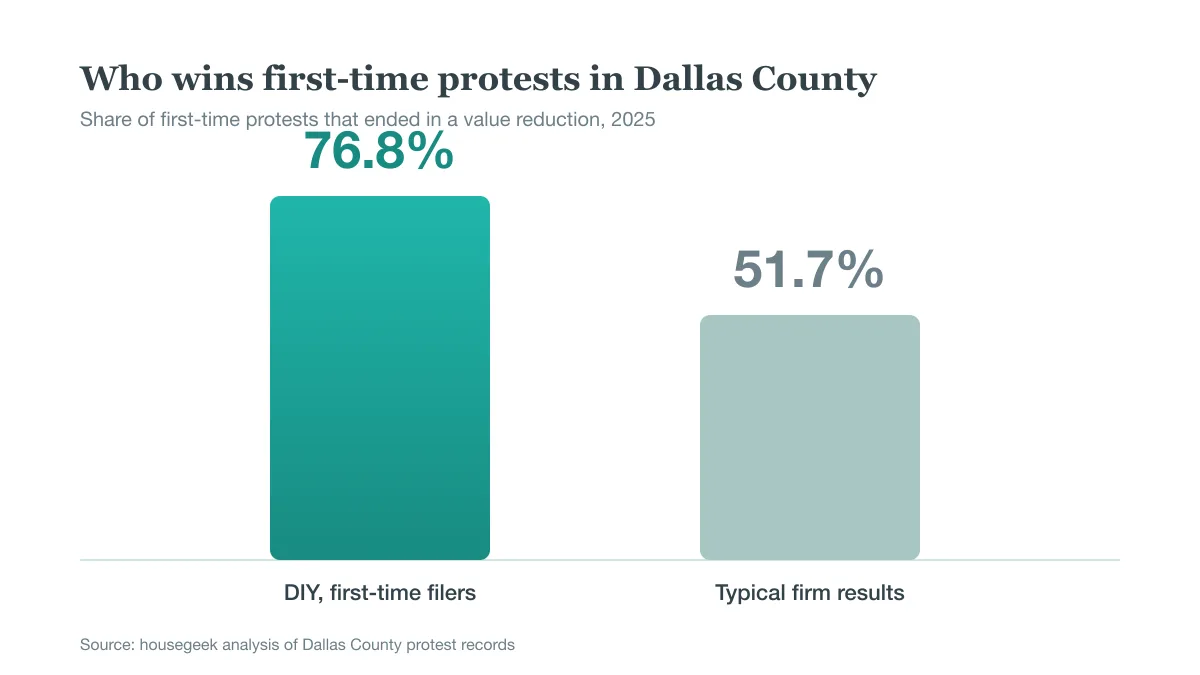
| First-time protest filers, Dallas County 2025 | Win rate | Average reduction in assessed value when they won |
|---|---|---|
| Homeowners filing on their own | 76.8% | See by-bucket figures below |
| Typical contingency firms | 51.7% | See by-bucket figures below |
Source: housegeek analysis of Dallas Central Appraisal District public protest records, 2025 protest year, first-time residential filers only. "Typical contingency firms" excludes the largest tech-forward national firm, which operates very differently and is broken out separately in our internal data.
For more on what protest season looked like from inside the system in 2026, see our recap of the year.
| Home value bucket | Average win amount, DIY | Average win amount, contingency firm |
|---|---|---|
| $100k to $250k | $25,819 | $12,443 |
| $250k to $500k | $29,846 | $15,312 |
| $500k to $750k | $40,430 | $26,881 |
The numbers above are reductions in assessed value, not in tax dollars. To convert a value reduction into actual dollars saved, multiply by your effective tax rate. In Dallas County, that rate is roughly 2.3% to 2.7% depending on your specific taxing jurisdictions and exemptions, so a $29,846 reduction translates to roughly $686 to $806 in tax savings for one year.
Are property tax protest companies worth it?
For most Texas homeowners with a residential property, no: the data shows a prepared homeowner wins more often and keeps everything. For complex properties or people who will never file, yes.
It is a fair question. Contingency firms have experience, software, and people who do this for a living. So why does the data show homeowners winning more often when they file on their own?
- Selection effects matter. Homeowners who file on their own are usually filing on properties they have personally examined and where they already see something off. Contingency firms file on a much wider book of business, including properties where the case is weak.
- Volume firms optimize for throughput, not your file. A typical contingency firm processes thousands of protests in a few weeks. Each one gets a small slice of attention. A homeowner filing on their own spends an hour on one property and brings personal context the firm cannot.
- Settlement targets are different. A firm needs to close cases quickly to move on to the next one. A homeowner can hold out for a better number because there is no opportunity cost on their next file.
- The evidence is the evidence. A good comparable sales analysis and an equal-and-uniform equity report look the same whether a homeowner or a firm prepares them. Once you have a credible packet, the appraiser looks at the data, not at who delivered it.
None of this means contingency firms are a bad deal for everyone. It means the gap between professional help and a well-prepared homeowner is much smaller than the marketing suggests, and on a per-property basis the homeowner often comes out ahead.
The Math on a Typical Dallas Home
Here is a worked example for a homeowner in the $250k to $500k bucket, which is the largest single residential value range in Dallas County. Numbers are rounded for clarity and use a 2.5% effective tax rate.
Scenario: $375,000 home, first-time protest
- DIY path. Pay $59.99 for a Full Playbook. Spend roughly an hour reviewing the comparable sales analysis, taking photos of any condition issues, and filing through the county portal. If you win at the typical DIY rate, your assessed value drops by about $29,846, your tax bill drops by about $746 the first year, and you keep all of it. Net first-year benefit: roughly $686.
- Contingency path. Pay $0 upfront. The firm files for you. If they win at the typical firm rate, your assessed value drops by about $15,312, your tax bill drops by about $383 the first year, and the firm takes 35% of that. You keep about $249. Net first-year benefit: roughly $249.
- Do nothing path. Net first-year benefit: $0. The protest window closes in May and your assessment becomes the basis for next year's notice.
The DIY benefit compounds. If your protest reduces your assessed value, that lower starting point carries forward into next year's notice as well. Contingency firms typically only take a percentage of the first year, but a homeowner who files annually keeps the compound benefit free of charge.
Why DIY Is Realistic Now
Filing your own protest used to mean digging through the appraisal district website, manually pulling comparable sales from Zillow and Redfin, learning the difference between market-value and equity arguments, and figuring out the file format the county would accept. That work is real, and it is the reason most homeowners outsourced it.
Three things have changed.
- Online filing is now the default. Both Dallas Central Appraisal District and Tarrant Appraisal District accept residential protests through their online portals. You upload your evidence and submit. There is no certified mail and no driving downtown. See our step-by-step Dallas County filing guide for exact screens and deadlines.
- Public protest data exists. Years of past protest results are now available as public records. That means it is possible to build a credible comparable sales analysis and an equal-and-uniform equity report from real data, not guesses.
- Flat-fee evidence packets exist. A handful of services, including housegeek, now sell prepared packets that pull the data, run the analysis, and hand you a file you can upload. The skill barrier that used to make DIY hard is mostly gone.
Who Should Not DIY
We are not going to pretend DIY is the right answer for every homeowner. There are real situations where a contingency firm or a paid consultant is the better call.
- Commercial and large multifamily properties. Income-approach valuation, complex depreciation arguments, and high-stakes appraisal review board hearings are well outside what a DIY packet is built for.
- Contested valuations on luxury homes. If your home is in the top 1% of your county and the valuation dispute is large enough that a $30,000 fee is rounding error compared to the savings, hiring an experienced consultant who knows the local appraisers may be worth it.
- Homeowners who simply will not file. This is the most honest reason. If you know you will pay for the packet and never get around to filing it, a contingency firm at least guarantees that something happens. A DIY product you do not use is worse than a contingency arrangement you ignore.
- Active disputes from prior years. If you are already in litigation, in a binding arbitration process, or in a District Court appeal from a prior year, you should not be your own attorney. Get professional help for those cases.
If you fall into one of those categories, a contingency firm or a paid hourly consultant is the right call. For the typical Dallas or Tarrant County homeowner with a residential property and an assessment that looks too high, the math favors DIY.
What You Get With housegeek
housegeek sells two flat-fee products designed for residential homeowners in Dallas and Tarrant County. Both are built around the same evidence the appraisal district uses, so the file you submit looks like the file a professional would submit.
- Evidence Pack. A comparable sales analysis, an equal-and-uniform equity report, and clear written instructions on how to document property condition with photos. This is the data. You do the photo work and the filing yourself.
- Full Playbook. Everything in the Evidence Pack, plus we incorporate your photos into a polished evidence packet, walk you through the county portal step by step, give you a hearing script, explain what to expect, and monitor your appraised value year over year so you know when to come back next spring.
Both products show you a preview of the data we found before you commit, so you can confirm there is something worth protesting before you spend the time. If the data suggests your appraisal is already fair, we will tell you that too.
Frequently Asked Questions
Are property tax protest companies worth it in Texas?
For most Texas homeowners with a residential property, no: the data shows a prepared homeowner wins more often and keeps everything. For complex properties or people who will never file, a contingency firm can still be worth the cut it takes.
Is filing a property tax protest in Texas hard?
Filing the protest itself is straightforward. Both Dallas Central Appraisal District and Tarrant Appraisal District accept residential protests through online portals. The hard part used to be assembling the evidence to support your case. A flat-fee evidence packet does that work for you.
What is the difference between DIY and a contingency firm?
A DIY product gives you the evidence and the instructions. You file. You pay a flat fee once and keep all of any savings. A contingency firm files on your behalf, charges nothing upfront, and takes a percentage of your first-year tax savings if they win. The trade-off is cost versus effort, and DIY is much cheaper if you are willing to spend an hour.
How much do property tax protest companies charge in Texas?
Texas contingency firms typically charge between 25% and 50% of your first-year tax savings. The most common range for residential properties is 35% to 45%. A few firms charge a percentage of the value reduction itself rather than the tax savings. None of them charge upfront.
What is the win rate for DIY property tax protests in Dallas?
In housegeek's analysis of Dallas County public protest records for 2025, residential homeowners filing on their own as first-time protesters won approximately 76.8% of the time. Typical contingency firms won approximately 51.7% of the time on first-time filings during the same period. Past performance does not guarantee future results, and your specific property may differ.
Will the appraisal district treat me worse if I file on my own?
No. Both Dallas Central Appraisal District and Tarrant Appraisal District process homeowner-filed protests through the same workflow as protests filed by professionals. The appraiser reviewing your file is looking at the evidence, not at who submitted it. There is no penalty for showing up on your own, and there is no record of how you filed in any database that affects future years.
Can I switch from a contingency firm to DIY next year?
Yes. Contingency firm contracts in Texas typically renew automatically each year unless you cancel. If you want to switch to DIY for the next protest cycle, send the firm a cancellation notice in writing before the next protest year begins. Keep a copy of the confirmation. Then file your own protest when the new notice arrives.
What happens if my DIY protest does not result in a reduction?
The protest itself costs nothing to file with the appraisal district. The only cost is the flat fee you paid for the evidence packet. housegeek customers whose protest does not result in a reduction receive 50% off the next year's packet as part of our Loyalty Guarantee. We cannot guarantee outcomes, but we can stand behind the product.
Why do so many Dallas homeowners not protest at all?
Roughly 61% of Dallas County residential property owners have not filed a protest in the last five years. The most common reasons we hear are uncertainty about whether the assessment is even too high, fear that protesting will trigger retaliation in future years, and the assumption that the process is too complicated to be worth the time. None of those reasons hold up when you look at the data, but they are widespread.
The Bottom Line
If your assessed value looks high, you have three options. Doing nothing costs you the most over time. Hiring a contingency firm costs you between a quarter and half of any savings, every year you renew. DIY with a flat-fee evidence packet costs you about an hour of your time and roughly $30 to $60 once, and on the Dallas County data we have seen, homeowners who file on their own win more often and win bigger than homeowners represented by typical firms.
For most residential homeowners in Dallas and Tarrant County, the math favors DIY. For complex properties, large disputes, or homeowners who know they will not actually file, a firm is the right call. Either way, the worst answer is doing nothing at all.
Ready to see if your property is a good candidate? Enter your address and we will pull your current assessment, run a comparable sales analysis, and tell you whether the data actually supports a protest before you spend a dollar. Check your property now.
"The biggest mistake we see is the homeowner who waits a year, watches their assessment go up again, and finally decides to act when they have already missed two protest windows. The data is the data. If your number is too high, the appraisal district will look at it. You just have to file." - housegeek Team